The graph below shows the generation by energy source for Duke Energy Carolina during the 5-day heat dome which occurred in late June 2025. Duke operated pumped storage hydro generation to meet peak demand on each of those hot sunny days and recharged the pumped storage capacity each night using electricity produced by conventional sources, predominantly natural gas and coal generation. There was also modest solar and hydro generation contribution to peak generation, but no wind contribution.

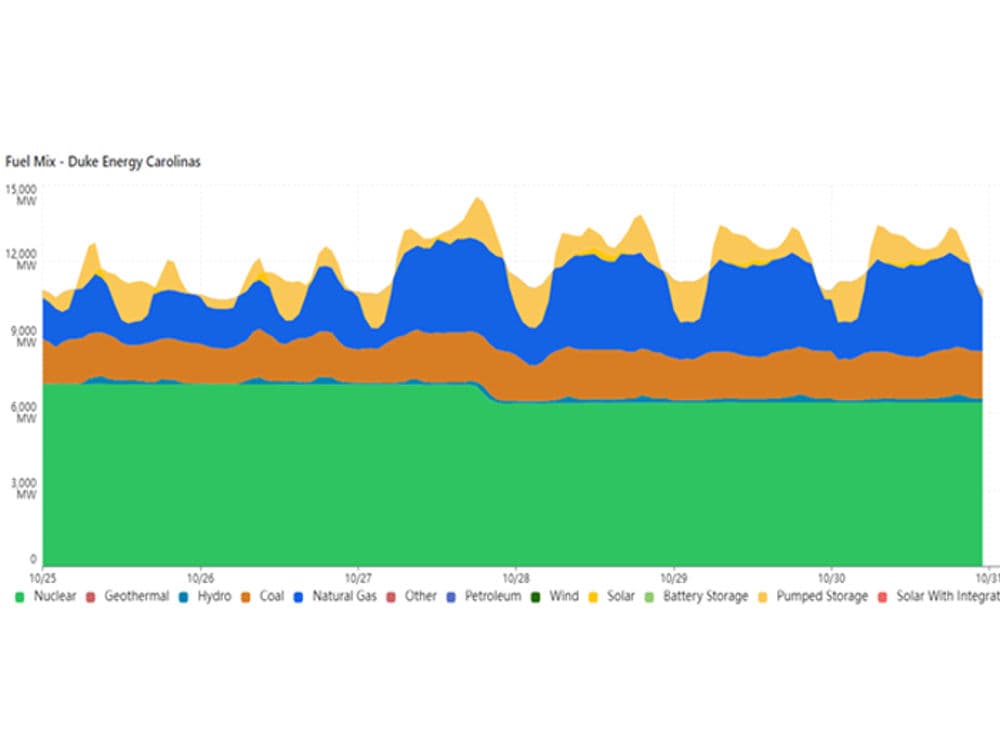
The graph below shows the generation by energy source for Duke Energy Carolina during the week of October 25th through 30th. The first two days are weekend days with lower peak demand. They were also bright, sunny days. Solar contribution peaked at 596 MW on the 25th and 723 MW on the 26th. Pumped storage contributed ~1100 MW to both peaks on the 25th but switched to recharge mode between the peaks when solar energy was most available. Pumped hydro also contributed to both peaks on the 26th and again switched to recharge mode between them when solar availability peaked.
The remaining 4 days shown in the graph were weekdays and were mostly cloudy with showers or rain throughout the days. Solar peaked briefly at ~290 MW over those days, while pumped hydro contributed 1,660 MW to the afternoon peak on the 27th, 1,500 MW on the 28th, and ~1,000 MW on the 29th and 30th. Pumped hydro recharged strongly each evening.
The predominant energy source over the entire period was nuclear. Coal generation was relatively consistent over the period, with natural gas generation responding to fluctuating demand and solar and pumped storage availability.

This graph shows a much more complex generation profile and provides some insight into the complexity imposed on electric grids.
Were Duke to proceed with a transition to a renewable plus storage grid, its current strategy of utilizing pumped storage generation on peak and recharging it at night would have to progressively reverse, since storage would then be required to replace the conventional generation currently providing power at night. Assuming no change in the nuclear generation capacity, this would require the addition of approximately 75,000 MWh of storage and approximately 125,000 MWh of additional renewable generation, assuming that renewable generation produced at capacity each day. Each day of low/no renewable generation would require an additional ~125,000 MWh of storage plus the additional generation capacity required to assure that storage was recharged and available for the next low/no renewable generation day. Generation capacity requirements would increase as a function of the number of days and the acceptable number of days to recharge storage in anticipation of the next low/no renewable day of low/no renewable generation.
Duke Energy Carolina has proposed construction of additional natural gas generation capacity to the North Carolina Utilities Commission in anticipation of load growth from data centers and AI. However, this planned expansion is being opposed advocates of solar generation including local solar.
- ORIGINAL CONTENT