symbiotic: characterized by a close, cooperative, or interdependent relationship (Merriam-Webster)
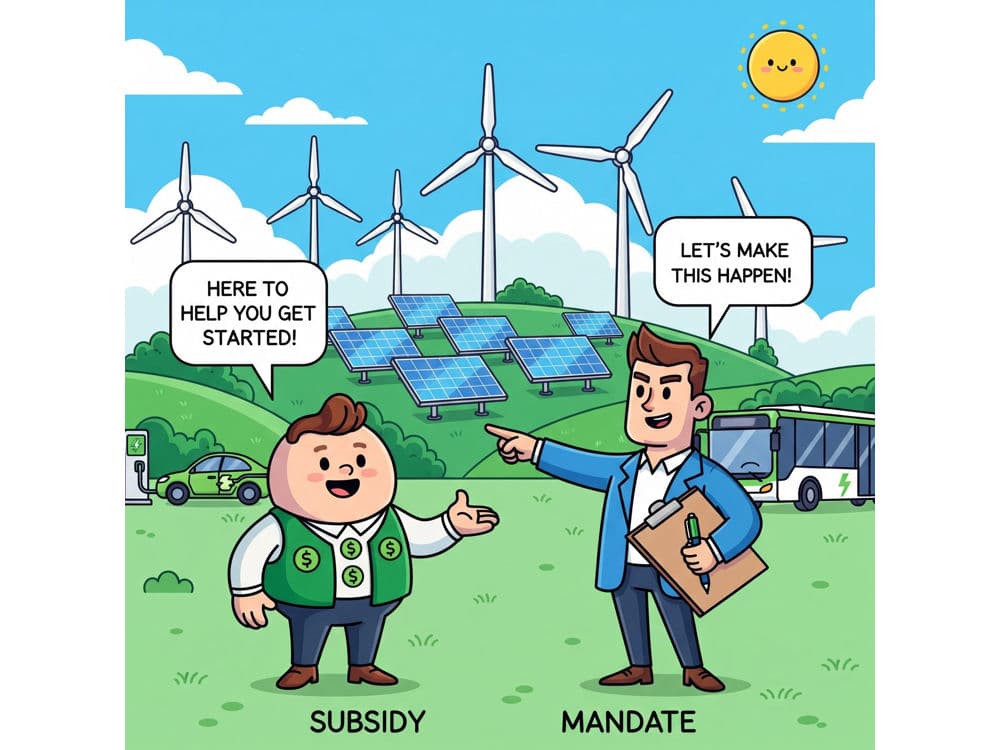
Subsidies are used to make the price of an alternative product or action as attractive as, or more attractive than, other available options. The magnitude of the subsidy is determined by the relative cost of the alternatives and their relative acceptability or desirability. Subsidies will cause some percentage of decision-makers to choose the subsidized product or action rather than the available alternatives. The larger the subsidy relative to the price of the subsidized product or action, or relative to the difference in price between the available alternatives, the higher the percentage of decisionmakers likely to choose the subsidized alternative. The relative attractiveness of the subsidy largely determines the rate at which the subsidized alternative penetrates the market, replacing the pre-existing options.
Mandates are an alternative approach to influence choices in the affected markets. Mandates create a guaranteed sub-market for the mandated product or action. Mandates established as part of the proposed energy transition typically required that the mandated product or action achieve some level of market penetration by some date certain .Mandates are essentially an other form of subsidy which eliminates or reduces the customer choice aspect of decision-making, frequently to assure that the market transition occurs more rapidly than would likely occur under the influence of any reasonable level of subsidies alone.
In the proposed energy transition, subsidies and mandates developed a symbiotic relationship. For example, the federal and state electric vehicle (EV) subsidies, while large, were judged to be insufficient to cause the desired vehicle market transition to occur at the desired pace, both because vehicle manufacturers would not produce the necessary number of vehicles and the vehicle purchasers would not choose EVs in sufficient numbers to achieve the desired market penetration by the desired dates.
The mandates created a sub-market large enough to force existing vehicle manufacturers to begin producing EVs and enticed a proliferation of new vehicle manufacturers to produce EVs as well Ultimately, the mandates could force the manufacturers to produce an adequate number of EVs, but could not force their purchase.
Mandates were also applied to electric generation at both the federal and state levels to force the adoption of renewable generation to displace and ultimately replace fossil fueled generation. The mandates were supported by the subsidies and incentives provided to renewable generation developers, since the issues associated with connecting remote renewable generation to the grid and adapting the grid to intermittent generation sources slowed the grid connection process significantly.
Incentives were also available for replacement of fossil fueled heating systems with heat pumps. No federal mandates were established, but some states did establish mandates to force adoption.
The federal mandates have now been rescinded and many of the federal incentives have been terminated or will be in the near future. Some of the state mandates have also been rescinded and it now appears that those which remain will not be satisfied on the established schedules.
- ORIGINAL CONTENT